Wednesday, May 18, 2011

Touring Turkey - The Kayamkli Underground City


Have you ever spent a few moments thinking, "No way! How did they do THAT?" Well, that was me for about three days in Cappadocia, and I think it was repeating this phrase the most when we visited the Kaymakli Underground City, essentially a labryinth of underground livable spaces.

There are over 100 underground tunnels that were constructed on a relatively steep incline. If you have any issues walking or are claustrophobic, I'd suggest passing on this part of a trip to Cappadocia. You'll see what I'm talking about below.

Apparently up to 2,000 people could live there for almost 2 months without having to come above ground. They and their horses (There were STABLES!) had all of the amenities possible with them and found ways to survive invasions that forced them underground. My dearest early Cappadocians, you are no joke. PROPS!!!

I have no idea how the early Cappadocians actually constructed these spaces. Adem, our guide from Heritage Travel, said that there were no engineers, no planning, no nothing (maybe he was being dramatic?). Half the time I can barely figure out how to put together a piece of Ikea furniture (or HTML, but that's another topic) much less just figure out how to make an entire underground world.

Wanna see?

Adem, our guide from Heritage Travel, giving us some basic facts. He was a great guide: super funny and taught us a lot about Turkish culture. We had a great conversation about the NBA. The Turks love basketball.


I have to admit that I forget if this was a living room or what. Nice built-in shelves though.


I don't remember what this is exactly, but many of these rooms were used for storage. Could you use a stone basket?


The Cappadocians were smart and didn't make it particular easy to get around the caves. Many of the passageways are narrow, and sometimes it required moving stones like these to even get into the next room (makes me appreciative of my door, Thankyouverymuch!!)
A door...more like a big 'ol rock!

The Cappadocians made sure to build just what they needed for short term living.


A makeshift huge mortar + pestle in the kitchen. It has been darkened by smoke.


Like I said above, the passageways here are narrow and sometimes steep. Plus, the rooms themselves are quite...snug.

Walking down to the lower floor. Close quarters!


Husband J had to bend down to take this pic. If you're over 6 feet, I suspect that you would be keeled over.


No room to even extend your arms upward! Please excuse the crazy eyes! ;)

So are you scratching your head, too? Could you, your family, and your HORSE live underground for a month? :)

Monday, May 16, 2011

Touring Turkey - Turkish Food Rundown, Part 2

**Hey, all! Well, Blogger went on a little vacation, i.e., it decided not to work, so therefore no post for me last Friday. Ugh! Any lovers of Wordpress, feel free to sing its praises in the comments section. I'm contemplating a change.**

I thought I'd continue talking about glorious Turkish food and show you some of what we ate while in the Cappadocia region. There's really not much going on restaurant-wise in Uchisar (that's probably an understatement), so we essentially stuck to our hotel's restaurant, Seki and another highly regarded (although not impressive, at least to me) restaurant, Elai, for our evening meals. For more restaurant variety, especially in the mid-range category, I'd suggest going to Goreme, the next town over if you decide to stay in Uchisar.

So, here's more of Turkey's varied cuisine...

Meze. Meze is a series of small dishes serving as an appetizer. It can include everything from commonly found hummus, eggplant salads (Patlican salatasi) to fried liver cubes (yum?). We had our first meze at Elai in Uchisar, considered one of the better restaurants in the Goreme/Uchisar area.
Meze plate at Elai restaurant in Uchisar
From left to right: Hummus, Cacik (cucumber with yogurt, mint and olive oil a.k.a tzatziki), Acili Ezme (spicy mashed tomato with onion and green herbs..the spiciest thing I had in Turkey!), and pepper stuffed with rice and currants.


Pide. Although it looks and sounds like pita, Turkish pide is distinctive from the pocket pitas prevalent in other countries. It's thicker and more like an actual pizza that a vessel for a sandwich. In Goreme, we had our first pizza-like pide at Mercan Restaurant right across from the bus station (The center of Goreme is not that big, so Mercan is easy to find).

Plain pide

Mixed Pide with egg, sausage, cheese and a pepperoni-like meat. Looks like pizza, doesn't it?


More meat and fruit mix....
Quail stuffed with spinach and dried fruits with a caramelized quince and teriyaki sauce at Seki, the restaurant at our hotel, Argos


Pumpkin for dessert. Actually this is tahin-pekmez, baked pumpkin with tahini (sesame paste) and grape syrup topped with walnuts. I was pretty surprised that I even liked this, but it was a great tart and sweet combination.

Baked pumpkin at Seki in the Argos Hotel

Those are some of the more unique dishes we ate while in Cappadocia. I'm still pretty shocked that we didn't have a bad meal in Turkey whether it was in our hotel, a small local place or even on the street. Turkish food is awesome!

Tuesday, May 10, 2011

Touring Turkey - Pasabag & The Fair Chimneys


On our last full day in Cappadocia (I'm still skipping around time wise), we spent the day with a private guide, Ibrahim, who works with Matiana Travel. I've only had a private guide once before, but I think Ibrahim was different. He was around our age, so it was like being with your cool friend who knows all of the spots to go to, lots of random bits of history and makes you laugh. You'll see him soon.

What the Cappadocia region is known for are the rock formations called fairy chimneys. I wish I could explain all of this in a really clear way, but I wasn't so good at 8th grade earth science. Here's a description of what they are and how they are made:

The peaks of three volcanoes - Erciyes, Hasan and Melendiz Daglari- dominate Cappadocia. It was their eruptions some thirty million years ago...that provided region's raw material: tuff. This soft stone, formed by compressed volcanic ash, has been worked ever since, by processes of erosion, to form valleys and curious fairy chimney rock...

The tuff surrounding basalt [another rock] is worn away, until it stands at the top of a large cone. Eventually the underpart is eaten away to such an extent that it can no longer hold its capital: the whole thing collapses and the process starts again.
-The Rough Guide to Turkey, p. 462


Yep. That's it. This erosion process produces a place that looks like this:

Fair Chimneys near Goreme

It's even more freaky (for lack of a better word) when you get to walk through them. You feel like you are on another planet. Please let me know if you have ever seen ANYTHING that resembles these formations. Hollywood has even taken note of Cappadocia's oddly beautiful setting: parts of it served as one of the sets for Nicolas Cage's next installment of Ghost Rider (I'm sure you all will be rushing to see that one. Ahem!)


Anyhoo, I was determined to make a quick jaunt through it all to get up close and personal with these rocks (and to see if I could find some fairies).


Staring off into the valley

I'm sure you're wondering why they are called "Fair Chimneys" in the first place, right? Well like most funky rocks in Cappadocia, people used to live in/near them. When invaders would come to this region (the Ottomans, Romans, whoever!), they saw the flickering lights from candles used by the area's residents. Supposedly, the lights looked little dancing fairies. Cute, huh?

These particular fair chimneys below happen to be my favorite. This is also one of my favorite pictures of me and Husband J from this trip.
Husband J and I at the Three Beauties Fair Chimney area

Here's a short unedited video (it's much more fun that way, I promise) at Pasabag, one of the more well-known fair chimney areas. You'll see the tuff mentioned above and hear and see a little of our guide, Ibrahim.

At PacabagTAO from TAOTerri on Vimeo.

After this post, I'm sure you can see why I fell in love with Cappadocia's eclectic beauty. Wouldn't you?

Monday, May 9, 2011

Apparently I'm Part of the Sights, Too.


There's a story behind this picture, and I'll eventually write about it. I'm still processing some of my experiences in Turkey, but I thought I would share this picture since it kind of captures some of my "admirers". In this case, it's partly funny....I guess. They were sweet teenage boys though. I think they were from somewhere in Eastern Turkey. I hope they enjoyed "seeing" me (or not seeing me depending on how you want to think about it) and seeing the Library at Celsus in Ephesus.


Check out my expression. Uh...

More on Ephesus and this experience soon.

Friday, May 6, 2011

Hometown Tourist - Brooklyn Chinatown


Brooklyn has a Chinatown. Yes, yes, y'all! I finally got to make my way around there last month. If you follow me on Facebook, you'll know that I linked to an article that I wrote for brooklynexposed.com about Brooklyn's Chinatown. That article wasn't my personal observations. I decided to save them for this blog, especially since it was my first time there and therefore perfect for a Hometown Tourist post!

When people think of Brooklyn, they tend not to think of a large Asian American community. Caribbean folks in Flatbush? Yes. Large Orthodox and Hassidic Jewish communities? Yeah. Old school traditional Italian neighborhoods? You bet. A Chinatown? Really? Yep. We got that that too. Some have speculated that the neighbhorhood grew out of Chinese Americans and new Chinese immigrants wanting a little more space and cheaper rents, so they hopped on the N and D subway lines from Manhattan's Chinatown and discovered the already culturally diverse Sunset Park area. Now 8th Avenue in Brooklyn between 45th and 62nd Street is most definitely a Chinatown. The easiest and best way to get to the heart of BK Chinatown quickly is to take the N line to the 8th Avenue stop.

A view down 8th Avenue towards the Verrazano Bridge

Can I say something else? I often feel a little out of place even in the Manhattan Chinatown, so I made a point of coming here by myself as a means of getting myself out of my comfort zone. Why uncomfortable? Well, I'm obviously not Asian and don't always know the best thing to order. Also I've had some "interesting" interactions with shopkeepers in Manhattan's Chinatown ("You don't want to sell me that fish? Why not?"), so I was not sure what to expect. My fellow Brooklynites in Chinatown were super cool (except in one instance), so maybe I should just attribute all that 'tude to "Manhattan-ness" (Just kidding!)? ;)

You all have to know that I was going to go look for some food. Hello! There was waaay too much super cheap and tasty looking eats around, and it would probably take someone months to eat it all (anyone want to do an experiment?). I stopped off first at Kai Feng Du Dumpling House. Let's be honest. This is NOT the place to go for atmosphere and decor, but you should definitely go for the dumplings.


I probably should have ordered less but at $2 for an order of 8, it was hard to say no. The dumplings were not too doughy, seasoned very well and chewy in a good way. Most of the dumplings have some variation of pork, but there are veggie options, too. If you don't mind the extra wait, get the steamed dumplings like I did.

I also had a bigger than expected scallion pancake, which was really bread.

In the makeshift dining area, I struck up a conversation with this really nice man. When he ran outside, I took a pic of his noodle soup with beef.

After lots more walking, I wanted a little more refreshment than water and stumbled onto Kung Fu Tea. I totally liked the modern interor and young vibe inside the shop. I do like bubble tea, but I wasn't sure what to get. I found the younger women who worked there to be pretty helpful. I settled on the passion fruit black tea with tapioca pearls, their most popular tea. It was delicious, so I understand the popularity.


Next time, I am going to get really adventurous and get their Red Wow milk tea: it's condensed milk, black tea, red beans and tapioca pearls. The taste of red beans is surprisingly nice, so I think this will be a nice treat.

I know that many enjoy Chinatowns everywhere for the shopping opportunities, and Brooklyn's seemed to have everything you could want.

Durian. I still haven't tried durian!


Some distinctive looking pastries. Next time I will be brave enough and not rushed so that I can buy some.

Most Brooklyn Chinatown stores are pretty small, but if you want more of a supermarket experience, I would head for Hong Kong supermarket for one-stop shopping.

There are things there that you can find in other shops on 8th Avenue, but I got super happy in the sauce aisle. There are so many things that I have wanted to have at home for certain home cooking that I do, and now I know where I can find them more easily in Brooklyn.

While Brooklyn Chinatown is a hub for eating and shopping, it's also a place for building a greater sense of community among the Chinese who live there. I happened to pass by this poster board that had a small crowd gathered in front of it. Since I don't read Chinese, I'm not sure what's on it. Advertisements? Job listings? News from home? Can anyone see anything and translate for me?


I passed by the Brooklyn Chinese-American Association and decided to research some more about them. In addition to providing social services for the area's elders and children, they coordinate the Brooklyn Chinese New Year Parade. That's got to go on my calendar for next year.

I was very appreciative of the really warm welcome I received at the Xi Fang Temple, a Buddhist temple right on 8th Avenue that was renovated for the community in 2007.


The temple's altar is beautiful, and I snapped this shot even though I was a little timid about taking pictures. The monk on duty (I think he was a monk? Am I getting this right?) was very nice, and we had a great conversation about the temple and its activities.

While this part of 8th Avenue's businesses are overwhelmingly Chinese, there are other cultures repping.
Ecuadorean food. I'm intrigued....I've never had Ecuadorean food.


Fabulous pho at Pho Cho Lon

I hope that this post and my article have piqued your interest in exploring this part of Brooklyn. I know I'll be looking to discover more of it. For addresses and more information than I've included here, check out my article about Brooklyn Chinatown on Brooklyn Exposed.

Happy Weekend!

Thursday, May 5, 2011

Touring Turkey - On the Way to the Goreme Open Air Museum


Cappadocia, Cappadocia, Cappadocia. If I can say anything about this region of Turkey, it will be that this is by far one of the most spectacular and haunting geological formations that I have ever seen. The kicker: people actually lived in many of them! They ate, slept, prayed, hid from invading enemies and basically hung out in caves and rooms built into these funky looking rocks.

Husband J and I were on our way on foot (about a mile away from the center of Goreme) to the Goreme Open Air Museum, one of the best preserved sites in the entire region, but I couldn't stop taking pictures. I felt bad for Husband J 'cause I think he just wanted to get there already. I was too smitten. These pictures are ON THE WAY to the museum. We hadn't even gotten there yet!


Horsies! Yes, I am grown woman who says horsies. What? ;)

So I just want to let you know that camels are not indigenous to Turkey, but they are available for a ride for a small fee. :)


Husband J and I got a kick out of this sign. "Wouldn't you like to ride on a camel? Nice experience, isn't it?" Uh...okay, if you put it that way. I don't like to make fun of slightly poor English idiomatic phrasing, but I thought this sign was too cute.
The sign is next to Husband J. Too cute!

Also beware of this little area right before the museum and next the camel rides. We entered it thinking, "Uh, where's the museum?" This area is marked "Goreme Open Air Museum", but it's really just some stalls to buy food and souvenirs. Although we didn't buy anything, we didn't realize that this wasn't the area outside the actual museum until we were half way through. The people who created that sign were SMART!

More on the ACTUAL Goreme Open Air Museum next week!

Tuesday, May 3, 2011

Touring Turkey - Faux Hiking in the Ilhara Valley


I'm going to start with our second day in Cappadocia. During our second day, we took a group day tour with Heritage Tours, a local tour company. We decided to see the region this way in an effort to not have to figure out maps, and so that Husband J wouldn't have to drive ('cause if you didn't know, I don't). I'll write more about the tour and our pretty cool guide, Adem, in another post.

I say that we "faux hiked" because the hike wasn't really all that hard. The path was a pretty easy walk with no real climbing. Fine for me! I have yet to be the super cool and outdoorsy type and do a hardcore hike somewhere. It will happen some day.

The Ilhara Valley is a 10 mi (16 km) gorge sandwiched between volcanic rock. We walked about 3km of the Valley, and it was actually quite relaxing, scenic and pleasantly cold even for me. Apparently it can get super hot down there, so maybe it wasn't such a bad thing to be there in the cold. All of these pics are overcast because it was super cold and grey the entire time we were in the Cappadocia region. You'll see sun at some point in my pics, just not here.


Have I even shown any pics of Husband J and I together? Here's one. There were stairs leading into the valley. Not hard.

I feel a little bit like a bad travel blogger, but honestly there's nothing much to say but that the Ilhara Valley place is beautiful. Enjoy the pics!


The Melendiz Stream


As with many parts of the Cappadocia region, there are churches built into rock. Many early Christians built churches into rock formations to be able to worship freely. They were often subjected to persecution and the area was often invaded for some reason or another. These cave churches and monasteries were built for protection. I'll be showing you some pretty crazy places where many Christians hid in another post. In the Ilhara Valley, the most notable church is the Agacalti Church (it's also the one closest to the stairs I showed you above). We were pretty impressed by the fact that the ceiling's frescoes were still in pretty good condition.

Agacalti Church ceiling fresco. Jesus surrounded by angels


Agacalti Church

We came across this little seating area during the hike. When it's warm, people stop for a drink or a snack by the stream.

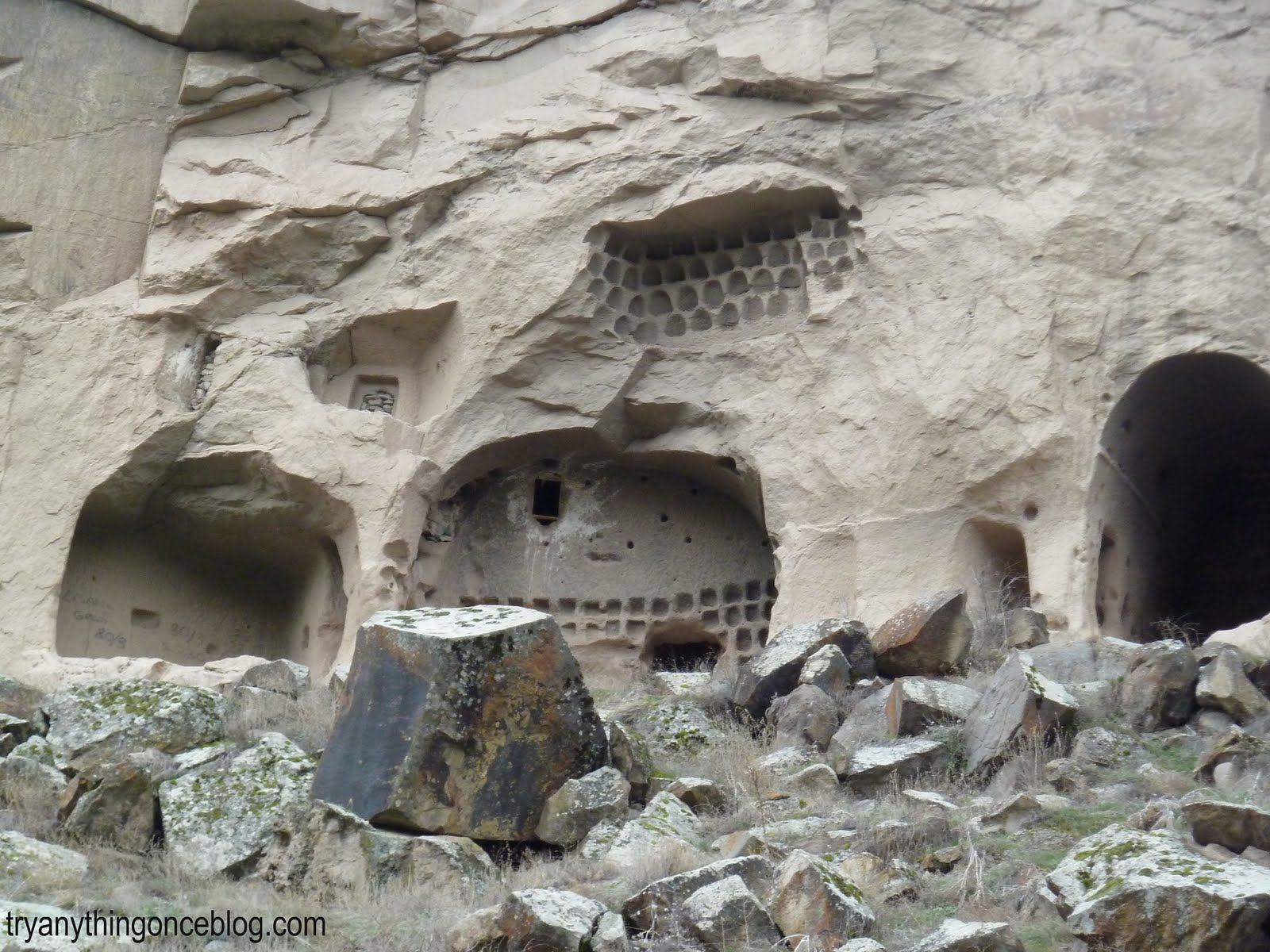
Do you see all of these little nooks in the pic below? They are used to collect pigeon poop. Apparently it is quite the fertilizer.

There is so much hiking to do in Cappadocia. In addition to the Ilhara Valley, check out the Sognali Valley.
 

Try Anything Once All rights reserved © 2010
I am a HowJoyful Design